The bottle has a handsome label, the shop smells of bread, and you are already imagining lunch at home. Olive oil is an easy thing to buy on feeling. Before paying, turn it around.
A useful purchase answers a few unglamorous questions: what grade is it, when were the olives harvested, where was the oil made, and how long will this much oil last in your kitchen? This is a researched buying guide, not a tasting panel or a ranking of brands. We have selected the checks below because they help with decisions you can actually make at the shelf.
Grade describes more than a marketing mood
Extra virgin and refined olive oil are different categories. In the USDA's grading definitions, extra virgin must meet sensory and chemical requirements, including fruitiness and an absence of sensory defects. Refined olive oil is defined as flavourless and odourless; the U.S. Olive Oil category is a blend of refined and virgin olive oils.
Those definitions explain why two bottles with similar designs need not offer the same experience. For a bottle whose flavour you want to notice on bread or at the table, our starting point is extra virgin. Read the actual category before the romantic landscape on the label.
The words alone do not independently verify what is inside. We are not certifying a bottle's purity, and a home tasting cannot replace laboratory analysis.
A harvest date and a packing address answer different questions
UC Davis's September 2026 buying guidance recommends looking for a recent harvest date. That tells you when the olives were picked; a best-by date does not supply the same information. If there is no harvest date, ask the seller rather than calculating one from the best-by label.
For a food souvenir, provenance deserves its own check. UC Davis also advises looking at where the oil was made, rather than where it was packaged. If your reason for buying is to bring home something from a particular region, ask about the oil's origin explicitly. A bottling address is an answer to a different question.
A useful shop conversation is short: Which harvest is this? Where was it produced? Can I taste it? Write down the answers if you are comparing several bottles; attractive labels become surprisingly difficult to distinguish from memory.
Buy for the kitchen you have
The biggest tin may be the lowest price per litre, but start with your rate of use. As a simple planning example, someone using 50ml a week would take ten weeks to finish 500ml; someone using 100ml a week would take five. These are arithmetic examples, not recommended serving amounts or shelf-life guarantees.
UC Food Quality's guidance recommends buying an amount you can use within weeks or a few months after opening and storing it somewhere cool and dark. Opening the container admits oxygen and speeds oxidation.
Our practical suggestion: buy a smaller quantity when exploring an unfamiliar oil, then consider a larger format once you know both that you like it and that you use it regularly. For a gift, think about the recipient's cooking habits rather than the visual impact of the container.
Packaging protects; tasting helps you choose
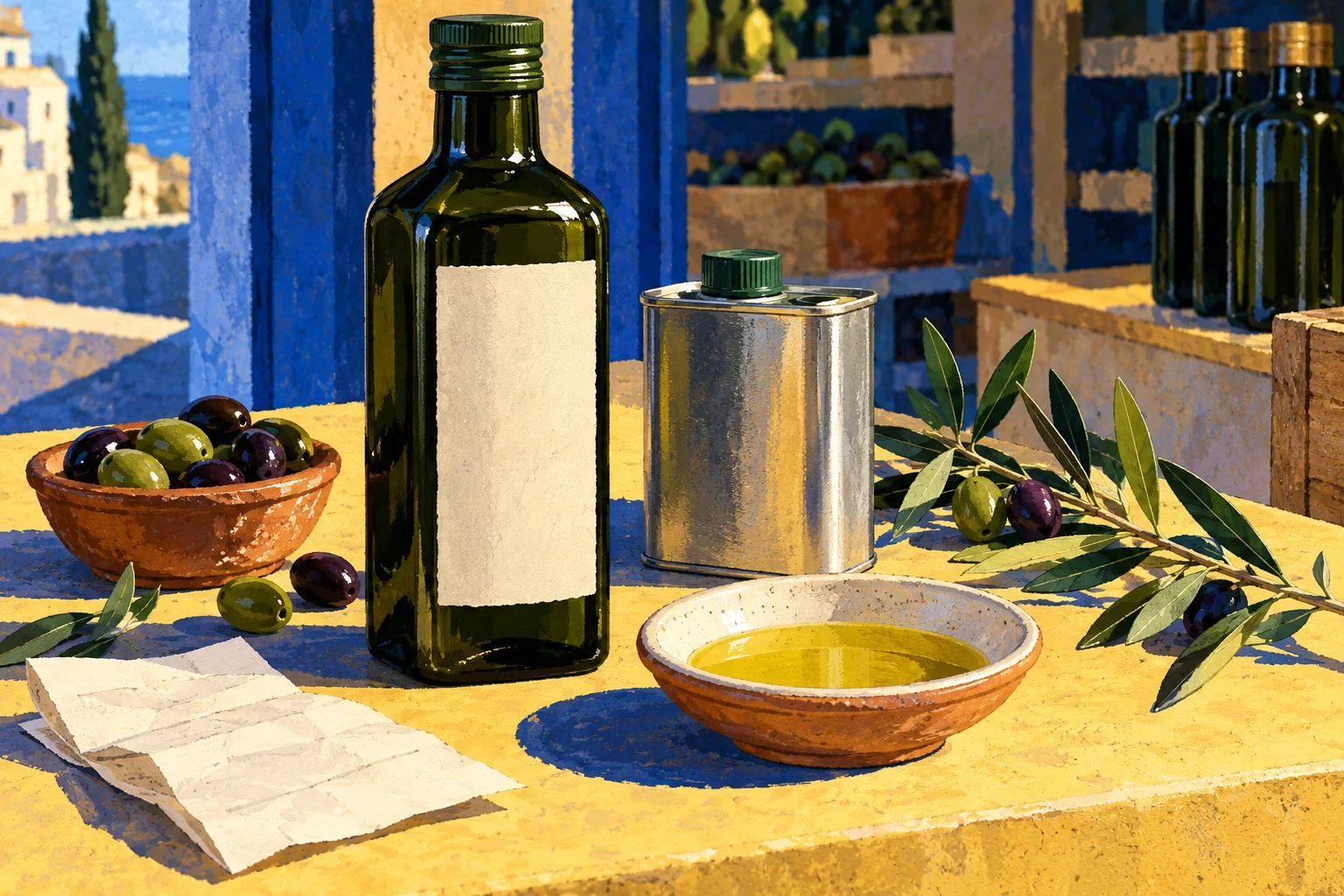
UC Davis's packaging review explains why dark or opaque containers matter: they reduce light exposure that accelerates oxidation. Metal tins exclude light, while dark glass reduces its penetration. That is a functional advantage, not proof that the contents are superior.
If samples are offered, use them to choose a flavour you enjoy. UC Davis notes that fresh extra virgin oil can be fruity, grassy, bitter or peppery. Green versus gold is not a dependable quality test, and neither colour nor a handsome package should decide the purchase for you.
At home, give the oil an actual job instead of saving it indefinitely for a special occasion. Our Margherita recipe uses a small amount alongside tomato, mozzarella and basil. Or simply choose the next meal where you want the oil's flavour to be part of the dish.
The photographs illustrate shelf labels and an olive-oil cruet. They are not endorsements of the pictured brands. The clear cruet is a serving still life, not our recommendation for long-term storage in daylight.
Sources checked 23 October 2026.