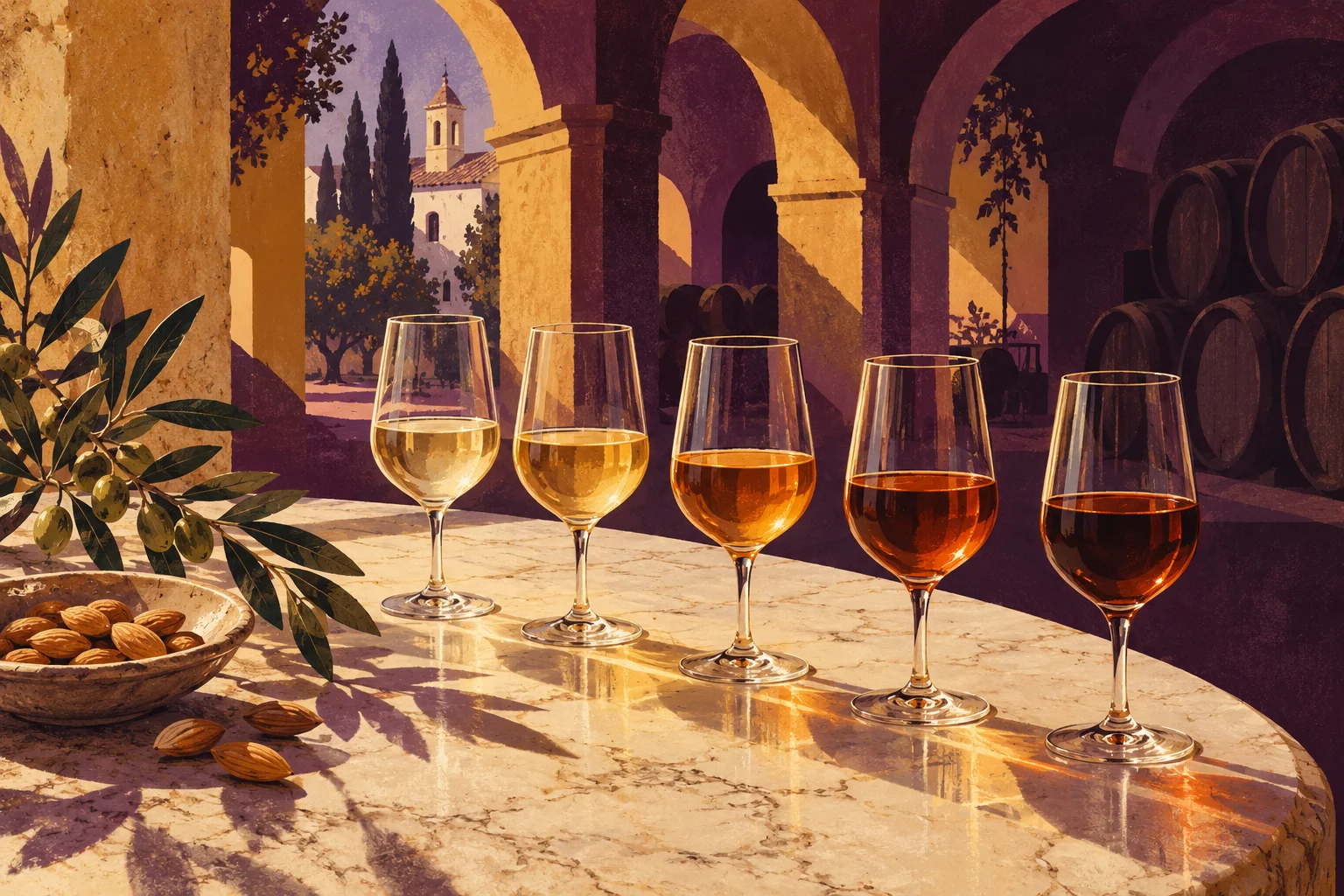
Start with one question: do you want something dry or something sweet? “Sherry” alone will not answer it. Neither will the colour of the wine.
These five styles offer a useful introduction to the range, from pale, dry wines to intensely sweet Pedro Ximénez. We selected them to explain differences in ageing, body and sweetness; the numbering is not a quality ranking or a complete catalogue. Descriptions and serving guidance below draw on the regional Consejo Regulador’s published information, not a POSTCARD tasting.
1. Fino: a dry starting point
Fino is made from palomino grapes and ages beneath flor, a layer of yeast. The council describes a light, dry style with almond, dough and herbal associations, and recommends serving it at 6–8°C.
That makes “a chilled fino” a more useful request than “a glass of sherry” when you want a dry aperitif. The council suggests olives, nuts and cured ham among its food matches. Treat those as starting points for a conversation about the bottle being poured, not a promise that every pairing will suit you.
2. Manzanilla: ask about Sanlúcar
Manzanilla also uses palomino and flor ageing, but that ageing takes place in Sanlúcar de Barrameda. It has its own protected designation within the wider sherry region.
The council’s profile emphasises a dry, delicate character, with floral and almond notes; its serving recommendation is also 6–8°C. Fish and seafood are suggested companions.
The useful distinction on a wine list is place as well as style. If you are choosing between a fino and a manzanilla, ask how the particular bottles differ. Two category names cannot capture every producer’s wine.
3. Amontillado: nutty does not mean sweet
Amontillado goes through two phases: first ageing under flor, then ageing with oxygen after that protection disappears. The council describes a dry finish and hazelnut-like aromas, with variation according to the time spent in each phase.
Its suggested serving range is 12–14°C. Mushrooms, white meat and semi-cured cheese appear among the food matches.
For ordering, this is the moment to separate aroma from sugar. If a menu says “nutty”, ask whether the wine is dry rather than translating the word into dessert wine in your head.
4. Oloroso: fuller-bodied, still dry
Oloroso ages oxidatively, without a protective flor layer. The council places it among dry wines and describes a fuller body, walnut-like aromas and colours from amber to mahogany.
Serve at the council’s recommended 12–14°C; its pairing suggestions include meat stews, mushrooms and mature cheeses.
This is the clearest reason not to order by colour. A dark-looking glass is not automatically sweet. Say “a dry oloroso” if that is what you want, and ask the server to identify the bottle rather than accepting “a rich sherry” as a complete description.
5. Pedro Ximénez: choose it for sweetness
Pedro Ximénez, often shortened to PX, takes the guide in a different direction. The grapes are dried in the sun to concentrate their sugars. The council describes an intensely sweet wine with dried-fruit associations and recommends 12–14°C, while noting that younger examples can be served cooler.
Its suggested partners include bitter-chocolate desserts, ice cream and strong blue cheeses. Choose it because you want that sweetness, not because a darker wine seems like the inevitable next step.
Turn the list into an order
Give the server three useful pieces of information: whether you want dry or sweet, whether you prefer a lighter or fuller style, and what you are eating. Then ask for the producer, pour size and price. That is enough to make a considered choice without pretending to know every name on the shelf.
For home serving, an ordinary white-wine glass is among the council’s suggested options; specialist glassware need not be your first purchase. Follow the bottle’s storage instructions rather than assuming all five styles behave identically after opening.
Prefer a fruit-led sparkling cocktail? Our peach Bellini guide explores a different way to begin the evening.
Research checked 18 October 2026. This is a style guide, with no specific bottle, bar or travel itinerary recommended. The Jerez photograph supplies regional context; the glasses photograph does not identify its contents as sherry. The illustrated cover is conceptual, not a colour-identification chart.