Your phone is at 12 per cent, the boarding queue is moving, and the power bank is somewhere inside the wheelie bag. This is the moment a little packing discipline earns its place.
A lithium power bank belongs in your cabin baggage, but permission to carry it does not automatically mean permission to use it. Check three separate things with the airline operating each flight: its capacity and quantity limits, where the bank must be stowed, and whether charging is allowed.
Start with the label, not the advertised phone charges
Find the manufacturer's watt-hour (Wh) rating on the bank itself. A large mAh number on the box is not enough to make the decision. CATSA's battery guidance gives the conversion as voltage multiplied by mAh, divided by 1,000. That calculation needs the correct battery voltage; do not guess it from the USB output specification.
Our practical preference is a clearly labelled bank whose rating you can read without searching an old order confirmation. Keep the manufacturer's specifications handy, too. A photograph of the label is useful for your own planning, but it is no substitute for a marking the airline requires on the device.
Two airlines show why a universal allowance is misleading
British Airways currently limits passengers to two power banks, each no more than 100Wh, with the capacity clearly labelled. Its guidance places them in the seat pocket or a bag under the seat. Aircraft seat power may charge a personal electronic device, but must not charge a power bank. Its approval process for larger batteries should not be read as permission to bring a larger power bank.
Lufthansa also limits passengers to two. Its power-bank section sets a standard maximum of 100Wh and separately requires airline approval for banks above 100Wh up to 160Wh. Both using and recharging power banks are prohibited on board, except for approved medical devices. They must remain on your person, in the seat pocket or in a bag under the seat, rather than in an overhead compartment.
These are examples checked on 23 October 2026, not a worldwide permission slip. Read the power-bank section for every operating carrier, including the return flight. A ticket sold by one airline may include a flight operated by another.
Make the gate-check handover uneventful
The FAA's PackSafe guidance requires spare lithium batteries and power banks to stay in the cabin. If your cabin bag is taken at the gate or aircraft door, remove them before handing it over. Protect battery terminals against short circuits.
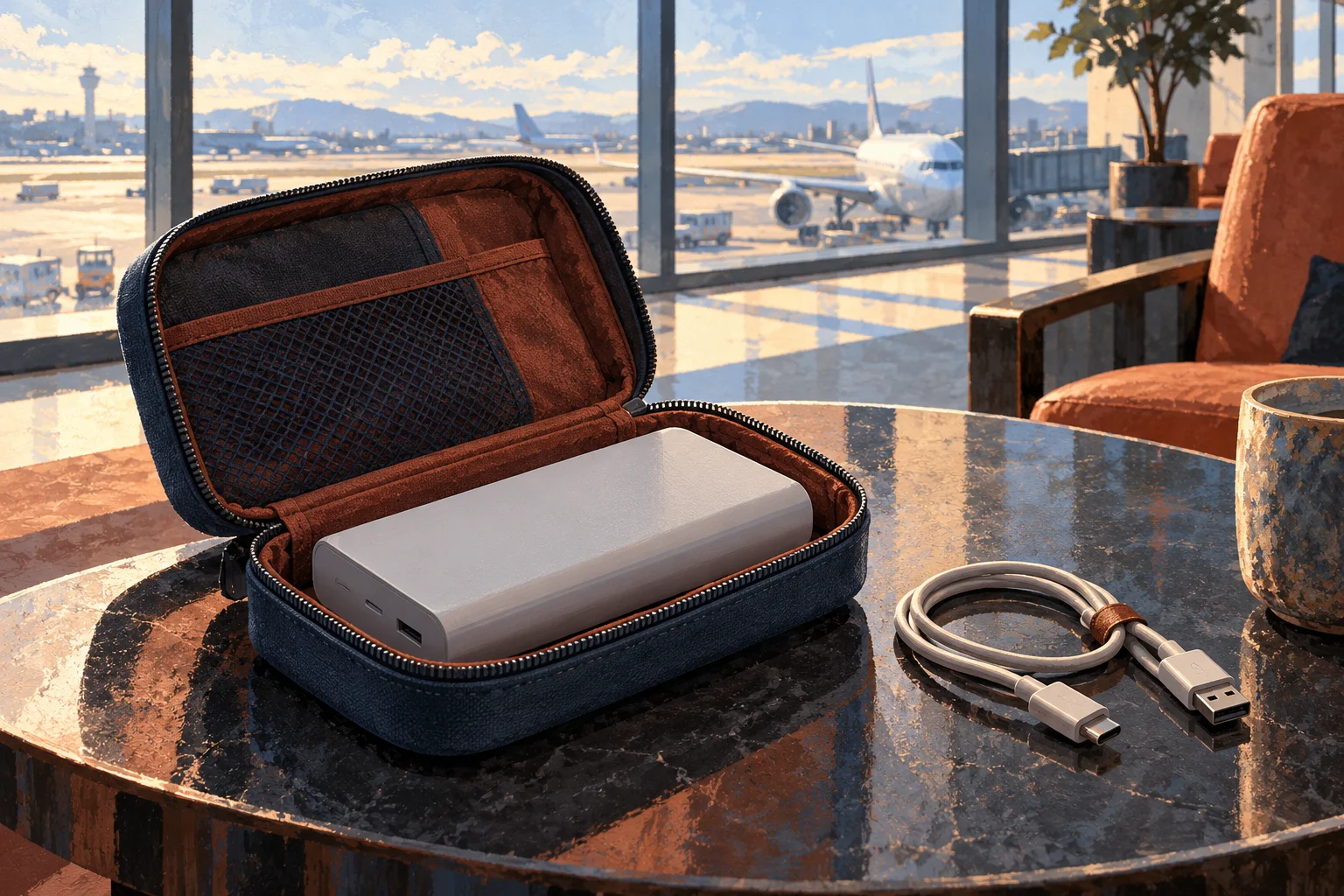
That is an argument for a small, accessible pouch, not a last-minute excavation beside the boarding scanner. Pack it where you can retrieve it even when your bag is full. Keep it separate from loose keys and coins, and make sure the pouch can move into the personal item you retain.
Do not travel with a damaged or safety-recalled bank. If a battery overheats, expands, smokes or burns, the FAA says to alert the crew immediately.
Plan to arrive with power without relying on the bank in flight
Charge your phone before departure and download the essentials you will want after landing: the accommodation address, your onward route and any available offline tickets. For a connection, check the next carrier's rules before leaving home, rather than assuming the first flight settles the question.
You may still find a power bank valuable on a long sightseeing day. The point is to plan its journey through the airport as carefully as its capacity. For the rest of the pouch, our compact travel-tech guide helps separate useful kit from duplicate cables; our adapter-versus-converter explainer covers a different question, charging from a wall socket abroad.
Photographs are contextual: Zoltan Tasi's image shows a power bank, not a tested or airline-approved recommendation. MeSSrro's image shows a phone on a wireless charging stand to illustrate charging before departure; it is not an aircraft setup.