A railway station usually asks you to keep moving. Dunedin's gives you reasons to linger: pale stonework against dark walls, a locomotive underfoot in the booking hall, and art galleries upstairs.
The useful discovery is that you can make the building itself the outing. The station's visitor information explicitly caters for people who are not catching a train. That makes it an appealing stop for an architecture-minded city day, even when a scenic excursion does not fit your time or budget.
Read the building from the outside in
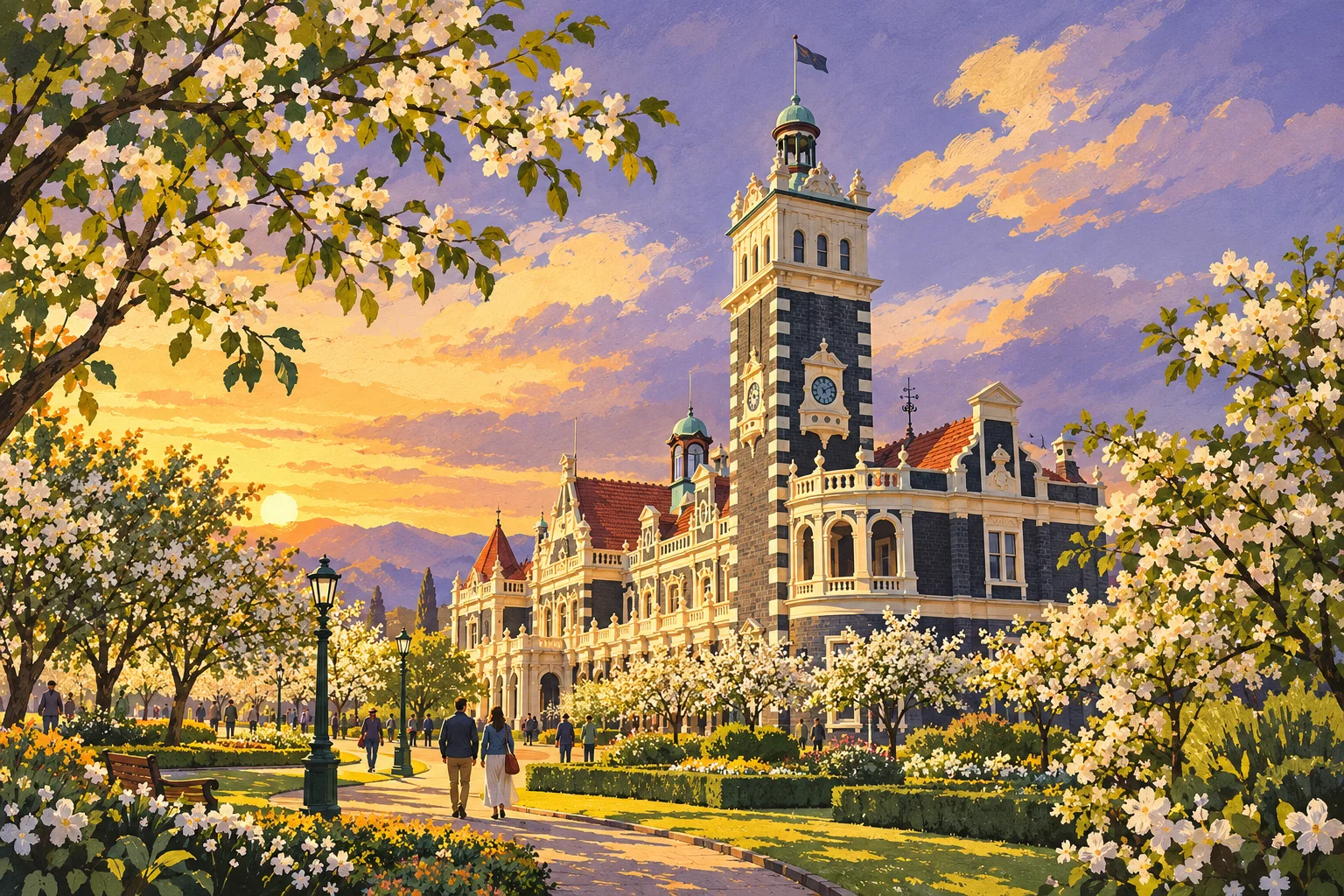
Tohu Whenua's heritage account describes the station's Flemish Renaissance design and its striking combination of white Oamaru limestone and black basalt. Built in 1906, it belongs to a period when railway architecture could make a grand statement about a city's ambitions.
Start with a little distance. Look at how the light-coloured trim picks out windows, corners and arches, then move closer to the clock tower. Inside, make the booking hall your focal point: the locomotive mosaic and railway-themed stained glass carry the building's purpose into its decoration. You do not need to be a rail enthusiast to enjoy that level of commitment.
Our suggestion is to treat the exterior and hall as the short version of the visit, then add the galleries if you have more time. It is a more rewarding approach than racing between a photograph of the façade and the next stop.
The upstairs reason to stay
The Otago Art Society occupies level one at 22 Anzac Avenue. Its current homepage lists public opening hours of 10am–4pm daily, with four galleries, a permanent collection and a gift shop. Exhibitions include members' work and shows drawing artists from elsewhere in New Zealand.
This adds a contemporary layer to the heritage building. Give the work upstairs its own attention rather than treating the rooms as a shortcut to another architectural view. If something catches your eye, the shop also offers a way to buy work by local artists; this is a browsing suggestion, not a recommendation of a particular piece.
Check the society's current hours before a special trip. The station's opening-hours guidance makes clear that businesses set their own schedules. A train departure time is not a reliable guide to gallery access.
Saturday changes the order
The Otago Farmers Market operates in the station's northern car park on Saturdays, 8am–12.30pm. It is a food market whose vendors come from the greater Otago region.
For a Saturday visit, our suggested order is market first, then the building and galleries once they open. That keeps the market's earlier finish from dictating a rushed exit halfway through an exhibition. Buy what suits the rest of your day: a modest picnic is easier to carry around town than groceries that need a refrigerator.
On another day, do not plan around market stalls being there. The architecture and galleries are the core of this visit; the market is a Saturday addition.
Access and the rest of your Dunedin stay
The operator's accessibility page identifies a ramp into the main foyer and a lift to the left of the main entrance. Contact the venue if you need to confirm a particular route or facility. Train boarding has separate arrangements, so do not assume building access answers that question.
For an overnight stay, compare accommodation against the places you actually plan to visit. The hotel-search link below covers Dunedin; it does not imply every result is beside the station. A room that works for your broader itinerary matters more than a promise of a station view.
Before arriving in the country, read our New Zealand food and outdoor-gear declaration guide. We checked Canada's New Zealand travel advice on 23 October 2026; its country-level advice was to take normal security precautions. Recheck official advice and the venue pages before travelling.
The photographs show the station exterior: Bernard Spragg. NZ's garden-side view was taken in 2008; Nareeta Martin's photograph studies the clock tower. They illustrate the architecture, not current planting or access conditions.