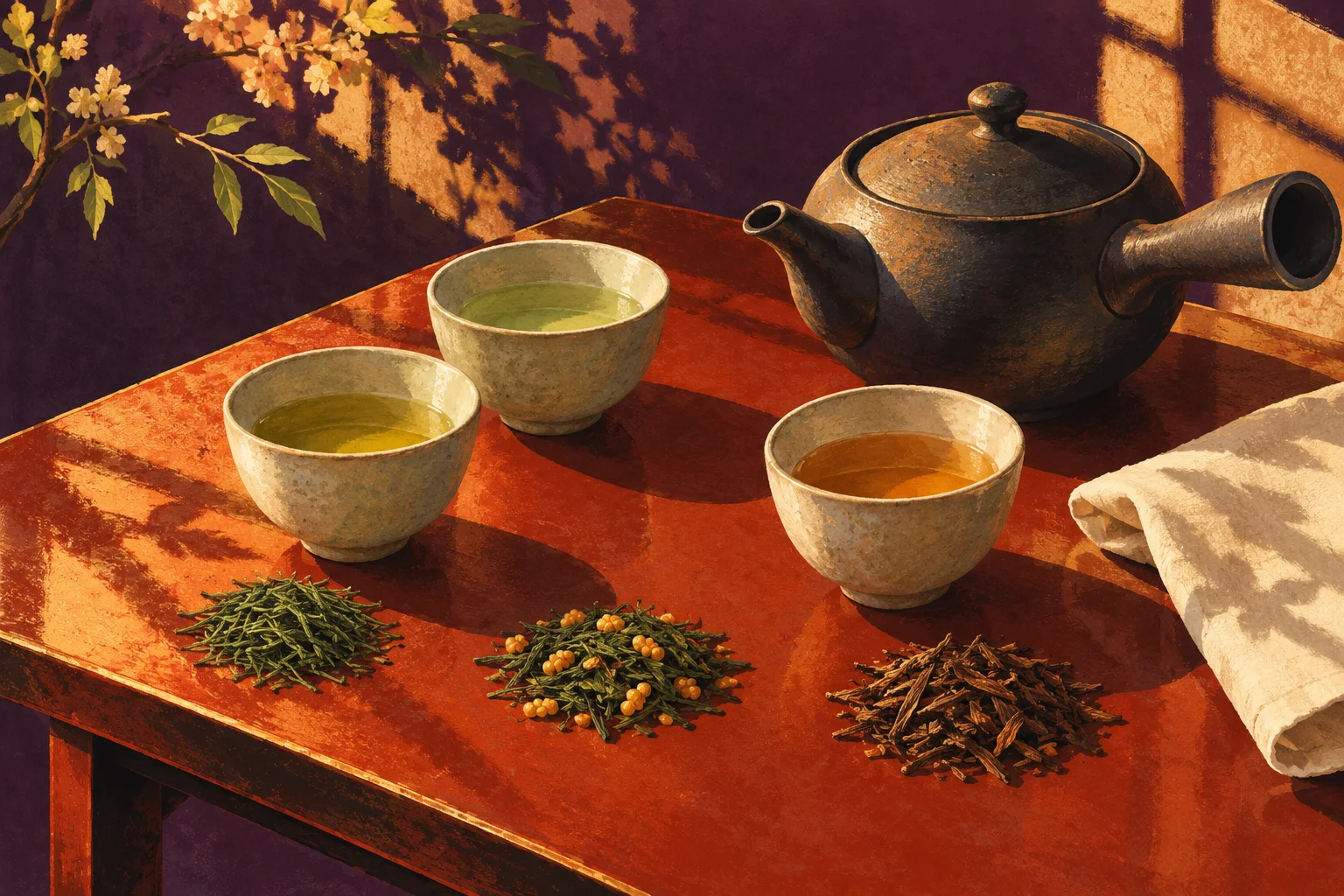
A row of Japanese tea packets can look like a choice between shades of green. The more useful question is what you want in the cup: the character of the tea leaf, the aroma of roasted rice, or the warmth of roasted tea.
Sencha, genmaicha and hojicha give you three distinct starting points. This is a researched buying guide, not a tasting test or a ranking of brands. We have chosen them because their ingredients and processing explain a practical choice you can make before opening a packet.
Sencha: start with the leaf
Sencha is a leaf tea. The Global Japanese Tea Association describes its characteristic needle-like shape and the process of steaming, rolling and drying the leaves. It is not matcha powder to whisk into water.
Choose it when you want the tea itself to lead. Ippodo’s guide to tea types describes sencha through sweetness, sharpness and a refreshing finish. That is a useful direction, not a promise that every packet will taste alike.
The name alone does not tell you everything: sencha can be shaded or unshaded, and it can come from different harvests. For a first purchase, our advice is to buy a modest quantity with clear brewing instructions rather than pay for an impressive description you cannot yet translate into a preference.
Genmaicha: read what accompanies the rice
Genmaicha combines tea with roasted rice. Its appeal is that rice aroma, but the blend deserves a second look. The Global Japanese Tea Association’s explanation notes that bancha is a common base, while sencha is also used.
Despite the familiar English description “brown-rice tea”, the rice used is not necessarily brown rice. And a packet labelled matcha-iri genmaicha includes matcha powder as well as the leaf-and-rice blend. If you want to compare two purchases, check the ingredients before assuming that the shared name makes them equivalent.
Choose genmaicha when the idea of roasted grain appeals more than a cup focused entirely on the leaf. For a useful first comparison, buy a plainly labelled blend and note whether it contains added matcha.
Hojicha: the roast is in the tea
Hojicha takes a different route. The Japan Hojicha Association explains that it is made by roasting finished teas such as sencha or bancha. The word describes processing; it does not require the packet to contain only leaves. Roasted stems can be part of the picture too.
This makes the shopping distinction straightforward: genmaicha brings roasted rice to tea; hojicha roasts the tea itself. Choose hojicha when that roasted aroma is what interests you. Check whether you are buying loose tea or a powder intended for a different preparation—the name on the front is not a complete set of instructions.
Give each packet its own brewing routine
Do not buy three different teas and then flatten the comparison with one automatic kettle-and-timer setting. Start with the instructions supplied for the tea you actually purchased.
For a concrete example, Ippodo’s basic sencha method uses 10g of tea, 210ml of water at 80°C and 60 seconds, counted from the start of pouring. Its basic hojicha and genmaicha method uses 10g, 240ml at 100°C and 30 seconds from the start of pouring.
Those are one producer’s recipes, not universal rules or POSTCARD-tested instructions. They demonstrate why the packet matters. Weighing the tea also makes the comparison more deliberate than using the same heaped spoon for very different leaves and blends.
What to bring home
Start with one small packet that matches the aroma you are curious about. If buying two, choose a contrast: sencha alongside hojicha, or sencha alongside genmaicha. Keep the packaging so you can repeat the preparation and identify what you liked when it is time to buy again.
Our recommendation is to spend your first purchase on learning a preference. A larger tin can wait. The same label-first approach is useful for another food souvenir: buying olive oil.
Photograph notes
The genmaicha photograph shows tea with toasted rice, by Selena N. B. H., via Wikimedia Commons, licensed CC BY 2.0. Resized and converted to WebP.
The hojicha photograph shows roasted leaves and stems: François Mathieu’s 2018 photograph of Hōjicha Co. Dark Roast, via Wikimedia Commons, licensed CC BY-SA 4.0. Resized and converted to WebP; the adapted image remains under that licence. It illustrates the tea style, not a tested product recommendation or endorsement.
Cover: original editorial illustration. Sources and image permissions checked October 25, 2026.